
GamerVapor, Part 2: Crawling a Social Network (the Data Engineering)
01 Aug 2019Written in September 2026, looking back; dated to when the project was built.
Part 1 introduced GamerVapor, a 2019 tool that predicted which users would leave the Steam community. Before any modeling could happen, I needed a dataset, and there wasn’t one to download. This post covers how I built it.
The source: the Steam Web API
Valve publishes a public web API (part of Steamworks) that returns information about Steam users, with more detail for public profiles. Three calls did most of the work: GetPlayerSummaries, GetFriendList and GetOwnedGames.
| Data | What it contains |
|---|---|
| User profile | When the account was created, profile and privacy settings, location, group (clan) membership, avatar, name, persona state, and last log-off |
| Friendships | Pairs of users, with the date each friendship started |
| Games | Games owned, and lifetime playtime for each |
The last log-off time gave me the label: anyone who hadn’t logged in for more than three months counted as churned. The friend list gave me something just as valuable: a way to find more users.
Network iteration: letting the friend graph do the sampling
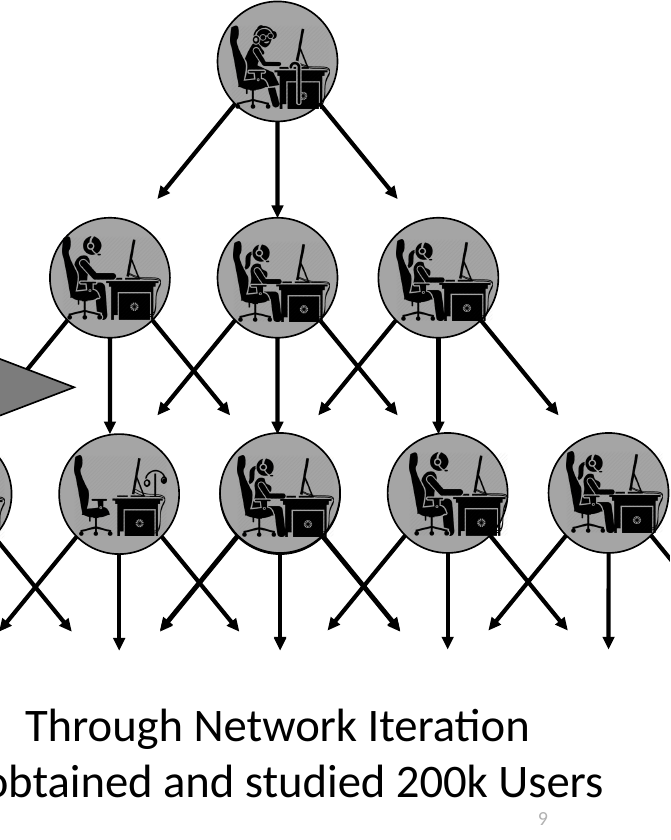
There’s no API call for “give me a random sample of Steam users”, but every user’s friend list points to more users. So the collection was a crawl through the friend graph, run in rounds:
- Start from a seed user.
- For each user in the current round, fetch their profile, games and friend list, and append the results to CSV files.
- Write every friend who hasn’t been processed yet to a list, which becomes the input for the next round.
The scraper kept a list of processed IDs so no one was fetched twice (and, according to a comment in the code, stopped at a million users so as not to “go crazy”). A notebook then merged the rounds into one dataset. Iterating outward like this, I collected and studied about 200,000 users. A second script also pulled per-game achievement data for user and game pairs.
It’s worth being honest about what this kind of sampling does. A crawl along friendships over-represents connected users and under-represents loners, because you can only reach someone through a friend. For a project whose main finding turned out to be about friendships, that’s a bias to keep in mind. The crawl structure also carried information of its own: I studied each user’s friendships in both directions of the crawl, “up” and “down” the tree, and some of those counts became features.
Public and private profiles
Steam users choose what their profile shows. Some profiles are public, with games, playtime and friends all visible. Others are private, so the API returns little more than a name and a login time.
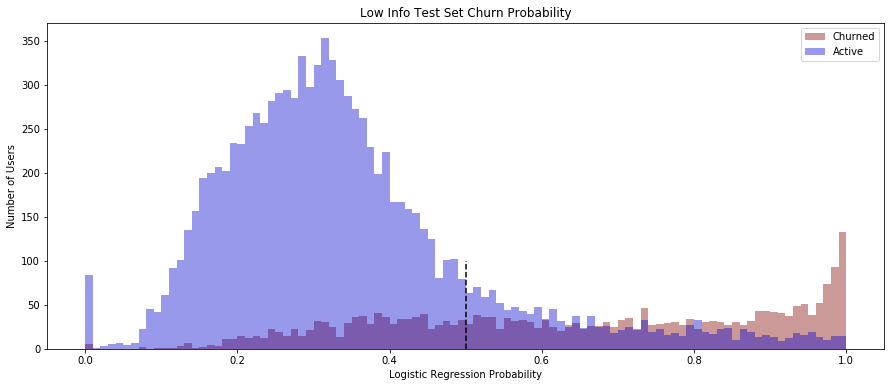
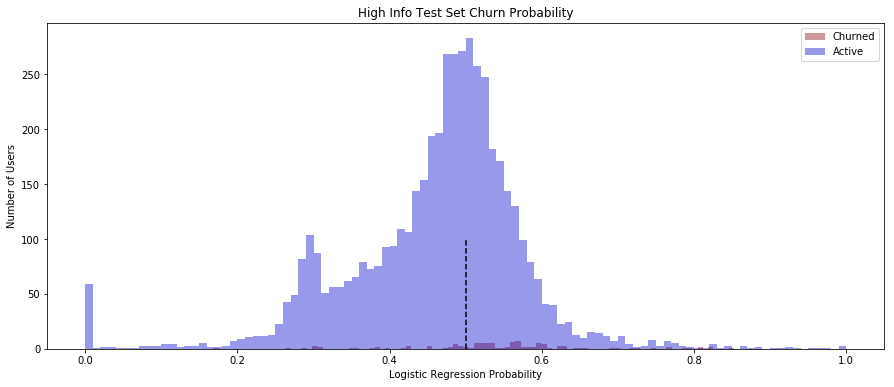 An early version of the model split users into high-information (top) and low-information (bottom) groups, with a separate classifier for each.
Missing data here isn’t random: choosing to hide your profile says something about how you use the platform. My first model version treated the two groups separately, with two classifiers. The final version folded profile settings in as features, so a single model could learn from them directly.
Storing it
Keeping it simple was the right call for a four-week project. The crawl wrote plain CSV files (player info, games per player, friendships), and everything downstream (merging rounds, cleaning, joins, feature building) happened in pandas in Jupyter notebooks. The data is naturally relational: users, friendships between pairs of users, and user–game ownership. A friends-of-friends statistic, such as the average number of friends your friends have, is just a couple of merges.
The database came at the end. Once the model was trained, every user’s churn probability, their friends’ average, and each “what if” score were precomputed and loaded into a PostgreSQL table. The Heroku web app just looked a user up by Steam ID, which kept it fast and cheap to run.
From raw data to features
The raw tables became 17 features per user, in four groups:
- Individual: for example, whether the user has a custom avatar, and when the account was created
- Community: for example, number of friends, and when the newest and oldest friendships started
- Game: for example, total lifetime playtime, and games owned but never played
- Hybrid: combining a user with their network, for example whether they share a favorite game with their friends, or how many games their friends own
Part 3 covers which of those mattered, and how much.
Looking back from 2026
The core pattern still holds up: find a source, crawl it respectfully, store it relationally, and turn it into features. A few things I’d do differently today:
- Snapshot over time. One crawl gives you one moment. Repeating it weekly would give the model real before-and-after data, instead of inferring change from timestamps.
- Think harder about the sample. A crawl along friendships gives you a very particular slice of the platform, and I’d measure that bias explicitly.
- Separate label time from feature time. Build features only from data before the churn window starts, so the model can’t peek at the outcome. The crawler and notebooks are on GitHub. More on why that matters in Part 3.